By Jon Selvaraj
Quick answer: To start government contracting, register your business in SAM.gov (free), get your UEI and CAGE code, pick your NAICS codes, and complete your reps and certs. Then learn to find and read opportunities, study past awards, and pick a narrow lane where you can win. Budget six to twelve months before your first prime award.
Key takeaways
- Registration is the gate, not the goal. Getting into SAM.gov is free and takes a few weeks, but it does not put work in front of you. Most of the effort that leads to a win happens after you're registered.
- A set-aside you don't qualify for is a wall, not a hurdle. If a solicitation is reserved for 8(a) firms and you aren't one, no amount of a strong proposal changes the outcome. Read that field first.
- Federal buyers repeat themselves. The fastest way to understand a customer is to read what they bought last year, from whom, and for how much. Past awards are public.
- Timing is a real factor. A lot of federal money moves on a fixed budget calendar, and knowing where an agency is in that cycle tells you whether an opportunity is close or a year out.
- Focus beats breadth in year one. Firms that win early usually do it by targeting a small set of agencies and codes, not by bidding everything.
What "government contracting" actually means
Federal contracting is the government buying goods and services from private companies under a written agreement. The buyer is an agency (the Army, the Department of Veterans Affairs, the General Services Administration, and hundreds more). The seller is a company like yours. The rules that govern the purchase come mostly from the Federal Acquisition Regulation, usually shortened to the FAR.
That's the whole model. An agency has a need and a budget, it publishes what it wants, companies respond, and the agency awards a contract. The reason it feels complicated is that the government spends public money, so the process is documented, competed, and auditable in ways that private-sector deals are not.
A quick distinction worth getting right early. A contract is the government paying you to deliver something it will use: janitorial service for a building, software licenses, a fleet of trucks, engineering support. A grant is the government funding something you will do for a public purpose, like research or a community program. The two run on different systems and different rules. This guide is about contracts. If you're chasing grants, most of the mechanics below don't apply. For a fuller breakdown of contract types and how they differ from other federal money, see What Are Federal Contracts?.
One more framing point before the mechanics. There are two ways to sell to the government. You can be a prime, holding the contract directly with the agency. Or you can be a subcontractor, working under another company that holds the prime contract. New entrants often start as subcontractors because it's a lower bar to entry and a way to build past performance. Both paths matter. This guide covers the prime path in detail, because that's where the registration and search mechanics are most involved, and the subcontracting path borrows most of the same groundwork.
Register in SAM.gov: the required first step
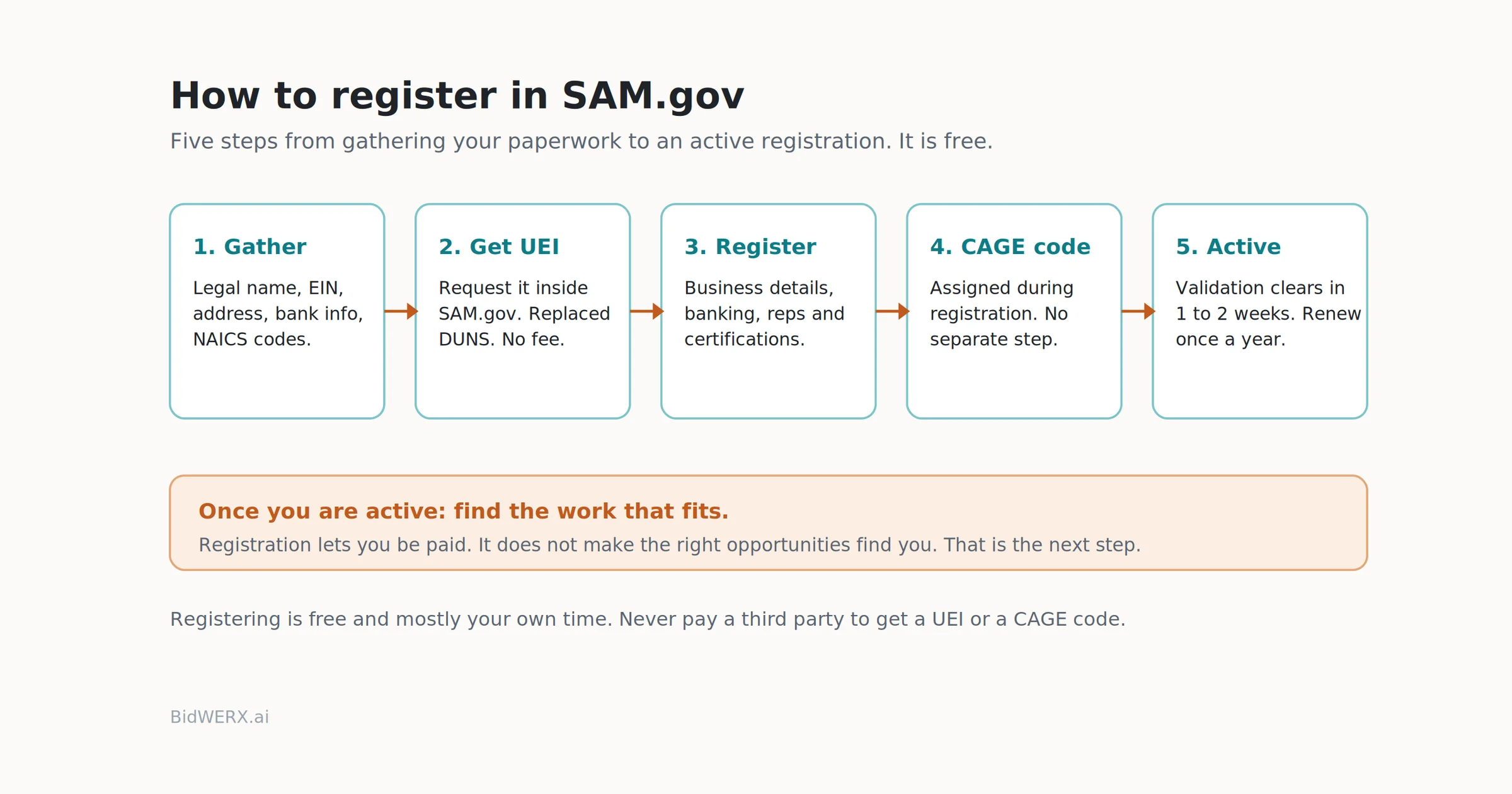
SAM.gov (the System for Award Management) is the federal government's central registration database. If you want to hold a prime contract, you have to be registered there and your registration has to be active. There is no way around this and there is no fee. Anyone who tells you registration costs money is a third party selling a service you can do yourself.
Here's the order the current process actually follows, so you know what's coming.
- Create your account through Login.gov. SAM.gov uses Login.gov for sign-in. Set that up first, then complete your SAM.gov user profile.
- Get your Unique Entity ID and pass entity validation. The UEI is a 12-character identifier the government uses to track your business. It replaced the old DUNS number in April 2022, so ignore any guidance that still mentions DUNS. To get the UEI, you provide your legal business name, physical address, and date and state of incorporation. SAM checks that against its records. If it finds a clean match, you're validated automatically. If it doesn't, you upload documents (articles of incorporation, a utility bill, that kind of thing) for a person to review. That review commonly runs one to three business days per submission, and it's the step that most often stalls people. Small mismatches between what you type and what your state filing says will trip it, so match your legal records exactly.
- Enter your core data. Business start date, fiscal year end, tax identification number (your EIN, or an SSN for some sole proprietors), ownership structure, and banking details so the government can pay you.
- Wait for the automated checks. The IRS matches your tax ID and name against its records, which takes a few business days. Then SAM hands your record to the Defense Logistics Agency, which assigns your CAGE code (a five-character identifier) at no cost. You don't apply for the CAGE code separately; it comes as part of registration. Foreign entities get an NCAGE code instead and have to obtain it first.
- Complete your assertions and your reps and certs. This is where you list your NAICS codes and answer the FAR representations and certifications questionnaire. More on both below.
- Assign your points of contact and submit. After you submit, activation can take up to ten business days.
So the honest timeline is a few days of your own effort spread across a few weeks of waiting on government systems. Plan for it to take three to four weeks start to finish, longer if entity validation kicks back your documents.
Two things people forget. First, registration expires. You have to renew every 365 days or your registration goes inactive, and an inactive registration makes you ineligible for award. Set a calendar reminder. Second, none of this generates leads. Registration makes you eligible to be paid; it does not tell the government you exist in any way that matters for winning work. That part comes later.
For a screen-by-screen walkthrough of the registration itself, including the entity-validation documents that cause the most trouble, see How to Register in SAM.gov.
NAICS codes, reps and certs, and the rest of your profile
A few pieces of your registration deserve more attention than the click-through suggests, because they shape which opportunities the government considers you for.
NAICS codes. NAICS (the North American Industry Classification System) is a numbered list of industries. Every federal opportunity is tagged with a NAICS code that describes the work. You select the codes that match what your business does. This matters for two reasons. It's how buyers and search tools associate you with relevant work, and it's how the government decides whether you count as a small business for a given opportunity. Size standards are set per NAICS code, some measured by average annual revenue and some by employee count. The same company can be "small" under one code and "not small" under another. Pick codes that genuinely describe your work. Padding the list with codes you can't actually perform doesn't help you and can hurt your credibility when a contracting officer checks.
Reps and certs. The representations and certifications are a questionnaire you complete in SAM. You're formally stating things the government relies on: that your firm isn't debarred or suspended, that you're current on federal taxes, how you comply with the Section 889 rules on certain telecom equipment, and (if you're going after Defense work) some DFARS-specific answers. These are legal representations, so read them rather than clicking through. They carry over into your contracts.
Socioeconomic status. If your business qualifies for a small-business program, this is where the profile starts to connect to it. The programs themselves (covered in the next section) are what open set-aside work, but your SAM profile is where much of that status becomes visible.
The full checklist of what a registered contractor is expected to have and maintain, including things like a compliant accounting approach for certain contract types, is in Federal Contractor Requirements.
Set-asides: the rule that decides who can even bid
This is the single most important concept for a new small business to understand, so I'll be direct about it.
The government reserves a large share of its contracts for small businesses, and within that, for specific categories of small business. When an opportunity is "set aside," only firms in that category are allowed to compete. If you don't qualify, you can't win it, and you usually can't even submit. The proposal quality is irrelevant because you never get to the part where quality is judged.
The main categories:
- Small business set-aside. Reserved for any firm that meets the SBA size standard for that NAICS code. This is the broadest one and the one most new entrants qualify for.
- 8(a) Business Development. For firms at least 51% owned and controlled by socially and economically disadvantaged U.S. citizens. It's a formal SBA program with a nine-year term and financial thresholds on the owner (personal net worth, adjusted gross income, total assets). You apply and get certified before you can pursue 8(a) work.
- Women-Owned Small Business (WOSB) and the economically disadvantaged version (EDWOSB). For firms at least 51% owned and controlled by women who are U.S. citizens. This now requires formal certification, not the old self-certification.
- HUBZone. For firms with a principal office in a Historically Underutilized Business Zone and at least 35% of employees living in one. Formally certified.
- Service-Disabled Veteran-Owned Small Business (SDVOSB). For firms owned and controlled by service-disabled veterans. As of the 2024 changes, this also runs through formal SBA certification rather than self-certification.
Two practical notes. Certification takes time, sometimes months, so if a program fits your ownership, start that process early rather than waiting until you see a contract you want. And a firm can hold more than one status. A veteran-owned, woman-owned company in a HUBZone can pursue opportunities set aside for any of those.
Here's why I'm putting set-asides ahead of "how to find opportunities." When you start searching, the set-aside field is the first thing to read on any listing, before the title, before the dollar value. If it's reserved for a category you're not in, you can stop reading. Getting fluent at that one filter will save you more time than almost anything else in your first year.
Finding opportunities: where the work is posted
Once you're registered and you know your codes and your eligibility, the question becomes finding work you can actually pursue.
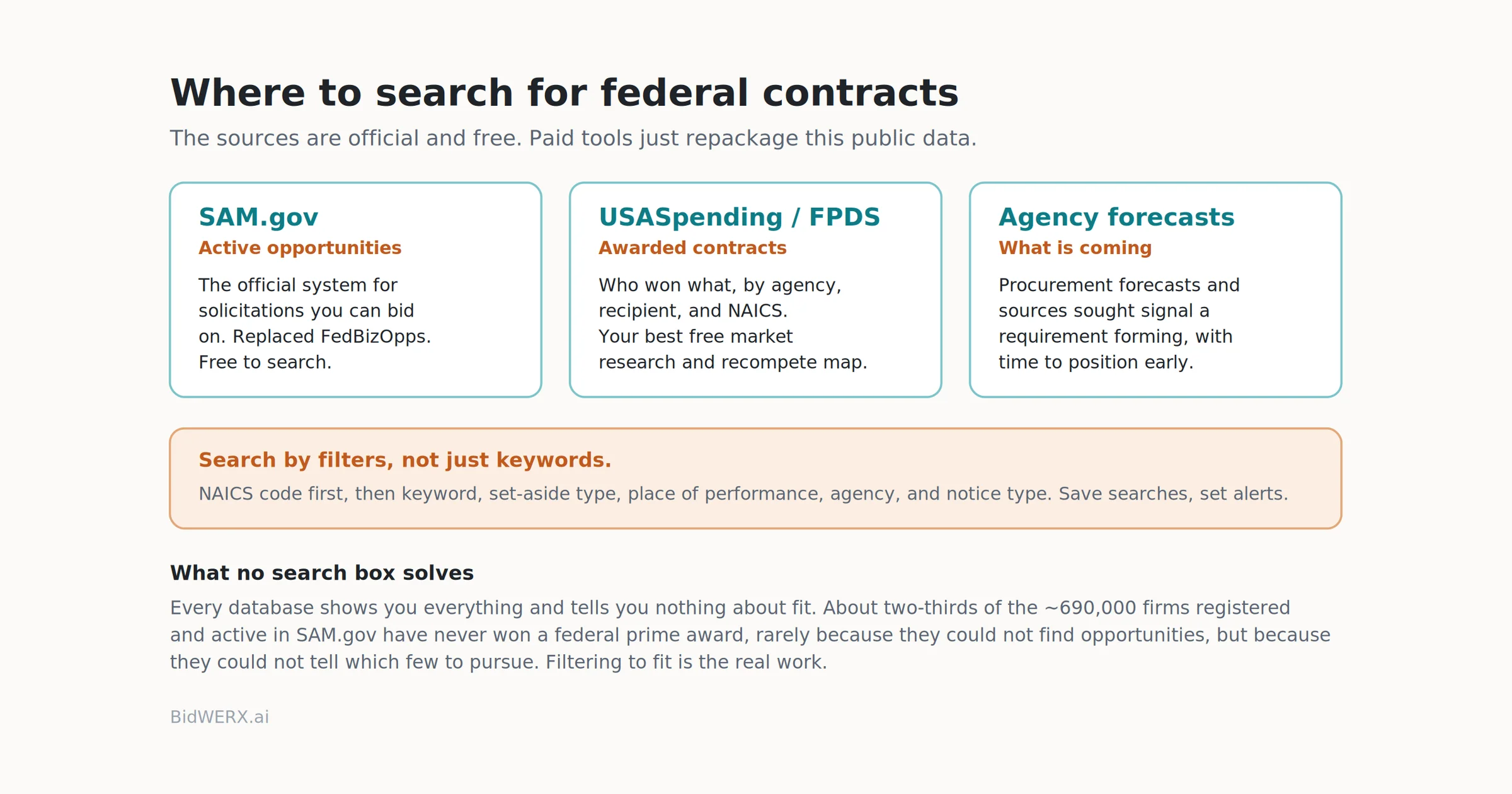
The government's official front door for contract opportunities is SAM.gov itself. Solicitations, sources-sought notices, and pre-solicitation announcements are posted there, searchable by keyword, NAICS code, set-aside type, agency, and date. (Grants are posted separately, on Grants.gov. Keep the two straight; they don't overlap.)
You can do real work with SAM.gov's own search, and every new contractor should learn it. The friction is that the volume is high and the interface is built for retrieval, not for judgment. You can find the notices, but you still have to open each one and work out whether it fits you, whether the set-aside lets you bid, and whether it's worth your time. Do that a hundred times a week and it becomes the job.
This is the point where an intelligence layer earns its place. BidWERX pulls from SAM.gov, with data feeds that are updated automatically each day, and its Find capability lets a team search and organize opportunities against the profile of what the business actually does. Find is available to the Org Admin and Capture Manager roles, which is a deliberate fit: those are the people responsible for deciding what an organization pursues. The point isn't to replace your reading of a solicitation. It's to cut the pile down to the ones worth reading.
For the mechanics of searching well, the keyword and filter combinations that surface relevant notices, and how to set up saved searches so opportunities come to you, see How to Find and Search Federal Contract Opportunities.
Reading fit: does this opportunity actually match you?
Finding an opportunity and judging whether to pursue it are different skills. Judgment is where new contractors lose the most time, because it's tempting to talk yourself into a bid you have no realistic shot at.
A structured way to read fit helps. Before anything else, check the set-aside, because it's a pass/fail gate. Then look at the NAICS code and size standard, the scope of work against what you've actually delivered, the incumbent (if there is one), and the timeline. Only after all of that does the writing of a proposal make sense.
BidWERX offers a FitScore to support this read. It takes a specific SAM.gov opportunity and reads it against what your business does, then gives you a score for how well the two line up. A few things are worth being precise about, because they define what the score is and isn't. FitScore reads SAM.gov opportunities only; it does not touch grants. The set-aside works as a hard gate: if the opportunity is reserved for a category you don't qualify for, the score is zeroed, which mirrors the real world where you simply can't win it. And the score is not predictive. It doesn't tell you your odds of winning or forecast an outcome. It's a structured read of alignment, meant to help you triage, not a crystal ball. FitScore is available on the Individual tier and up, so a solo operator can use it from day one.
Used honestly, a fit read does something useful for a small firm: it gives you permission to say no. Most opportunities aren't for you, and the sooner you can see that on a given listing, the more time you have for the few that are.
Read past awards: the customer tells you what it buys
Here's a habit that separates contractors who understand their market from those who guess at it. The government publishes what it has already bought. Every prime contract award is public: who won, which agency bought, what it was for, and how much it cost.
That record is a map. If you want to sell IT support to a particular agency, you can look up who's been providing it, on what contract vehicles, at what dollar levels, and when those contracts expire. An expiring contract is a future opportunity. A pattern of small awards to firms your size tells you the agency actually buys from companies like you. A market dominated by three large incumbents tells you the opposite, and it's better to learn that from public data than from a lost bid you spent three weeks on.
Past awards also help you price and scope. If similar work has consistently gone for a certain range, a bid far outside that range needs a reason. And when you eventually talk to a contracting officer or write a capability statement, referencing what the agency has bought shows you did your homework.
The full method, including where the award data lives and how to turn it into a target list of agencies and expiring contracts, is in How to Look Up Federal Contracts Already Awarded.
Who's who in a federal buy
Federal purchasing involves specific roles, and knowing who does what saves you from misdirected effort. Three come up constantly.
The Contracting Officer (CO) is the person with legal authority to bind the government to a contract. They sign, they obligate money, and they're the only one who can formally change the terms. When something is contractual, the CO is who it goes through.
The Contracting Officer's Representative (COR) is delegated by the CO to handle day-to-day technical oversight once work is underway. The COR watches whether the work is being done right and communicates with you on performance, but they can't change the contract. That distinction matters. A COR asking you to do extra work has no authority to commit the government to pay for it; only the CO can.
The Program Manager (PM) owns the mission need the contract exists to meet. They're the customer in the truest sense, the person who has the problem the work is supposed to solve. PMs often shape requirements long before a solicitation is published, which is why relationships and market research during the pre-solicitation window matter.
Understanding these roles changes how you spend your time. Early market research and relationship-building point toward program staff. Anything binding runs through the CO. Performance conversations happen with the COR. Sending a pricing question to the wrong person just delays your answer. The full picture of how these roles interact across a buy is in CO, COR, and PM: Who's Who in a Federal Buy.
Timing: why the budget cycle decides when you win
New contractors often assume federal money flows evenly through the year. It doesn't. A large share of it moves on a budget calendar that's set well in advance, and where an agency sits in that calendar affects whether an opportunity is imminent or a year away.
The federal fiscal year runs October 1 through September 30. Spending tends to cluster near the end of it, in the summer months, as agencies obligate funds before they expire. That's a real, observable pattern, and it's part of why so much activity shows up in the fourth fiscal quarter.
Underneath the annual rhythm is a longer planning process, most visible in the Defense Department, called PPBE (Planning, Programming, Budgeting, and Execution). It's how requirements and money get lined up years ahead of the contract you eventually see posted. For a small business, the practical value of understanding it is timing. If you know a program is still in the planning stages, you know the work is not close and you can invest accordingly. If you know funds are appropriated and the fiscal year is winding down, you know a purchase may be near. That awareness keeps you from chasing something that isn't real yet, and from missing something that is.
The full explanation of the cycle and how to read where an opportunity sits in it is in How the Defense Budget Cycle (PPBE) Decides When You'll Win.
A realistic first-year plan
Let me put the pieces into a sequence, because the order you do things in matters as much as the things themselves. This isn't the only path, but it's a sound one.
Months 1 to 2: Get eligible. Complete your SAM.gov registration, get your UEI and CAGE code, choose your NAICS codes carefully, and finish your reps and certs. If your ownership qualifies for a small-business program, start that certification now, because it takes months and you don't want it to be the thing holding you back later.
Months 2 to 4: Learn your market. Before you chase anything, study it. Pull past awards in your NAICS codes. Identify which agencies buy what you sell, who the incumbents are, and when their contracts expire. Build a short list of target agencies. Read a dozen solicitations end to end, even ones you won't bid, just to learn how they're written and what they ask for.
Months 3 to 6: Set up your pipeline and pick a lane. Configure searches so relevant opportunities reach you instead of you hunting daily. Start reading fit deliberately, checking the set-aside first and being honest about scope. Consider subcontracting as an entry point; teaming under an established prime is a legitimate way to earn past performance while you're still small and unproven as a prime.
Months 6 to 12: Bid selectively and build past performance. Respond to sources-sought notices to get on agencies' radar early. Bid the opportunities that genuinely fit, and put real effort into a few rather than thin effort into many. Expect to lose some. Each proposal teaches you something about that customer, and a debrief after a loss is worth requesting.
Here's the part that's easy to skip and shouldn't be. Most registered firms never win anything. About two-thirds of the nearly 690,000 firms registered and active in SAM.gov have not won a single federal prime award in the last thirteen years (FY2014 to FY2026). That number isn't meant to discourage you. It's meant to correct a common assumption, which is that registration is most of the work. It isn't. The firms that stay in the two-thirds are usually the ones that registered, listed themselves everywhere, and then waited for the phone to ring. The firms that win are the ones that picked a narrow lane, learned a specific customer deeply, and pursued a small number of well-matched opportunities with patience. Focus is the whole strategy.
About the author
Jon Selvaraj has spent about thirty years across federal contracting and Big Four consulting, working on the operator's side of how the government buys and how companies win that work. He is co-founder of BidWERX, where he builds tools that help small businesses find and judge federal opportunities. He writes here about the mechanics of getting started, drawn from doing the work rather than describing it from the outside.
Get started
If you're registered and ready to find work that actually fits, BidWERX helps you cut the noise. Search SAM.gov opportunities against what your business does, and read each one's fit before you spend a week on a proposal you can't win. Create your BidWERX account and start with the opportunities worth your time.
Last updated: September 29, 2026. Federal registration steps, set-aside rules, and program thresholds change over time; verify current details on SAM.gov and SBA.gov before you act on them.
How much does it cost to register in SAM.gov?
Nothing. Registration, your UEI, and your CAGE code are all free through SAM.gov. Companies that charge you for "registration assistance" are third parties, and the work is straightforward enough that most small businesses can do it themselves.
How long before I can realistically win my first contract?
Plan for six to twelve months from registration to a first prime award, and understand that many firms take longer or never get there. The registration itself is a few weeks. The rest of that time is learning your market, building a pipeline, and bidding selectively. Subcontracting under an established prime can be faster and is a common way in.
Do I need to be a certified small business to sell to the government?
No. Plenty of federal work is competed openly. But a large share is set aside for small businesses and specific categories within that, so certifications you qualify for (8(a), WOSB, HUBZone, SDVOSB) open doors that are otherwise closed. Check the set-aside on every opportunity, because it decides whether you're even allowed to bid.
What's the difference between a contract and a grant?
A contract is the government paying you to deliver something it will use. A grant funds something you'll do for a public purpose, like research. They run on different systems (contracts on SAM.gov, grants on Grants.gov) and different rules. This guide is about contracts.
What's the single most common mistake new contractors make?
Treating registration as the finish line and bidding everything in sight. Registration only makes you eligible. Winning comes from picking a narrow set of agencies and NAICS codes, studying what those customers actually buy, and pursuing a handful of well-matched opportunities rather than spraying proposals across the board.
Can I use software to find opportunities, or do I have to search SAM.gov manually?
You can and should learn SAM.gov's own search; it's the official source and it's free. Tools like BidWERX add a layer on top of that data (updated automatically each day) to help you filter to relevant opportunities faster and read how well each one fits what you do. The tool narrows the pile; you still make the call on each one.